Selections from a Commonplace Book
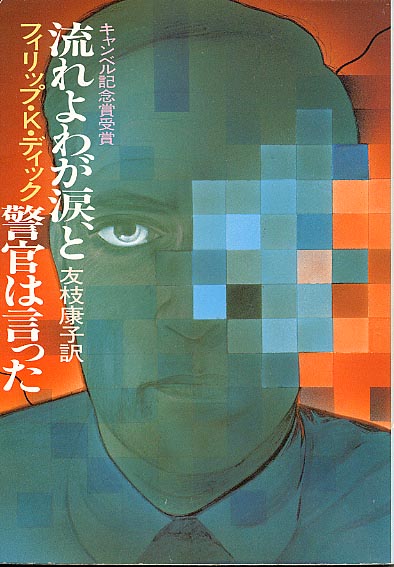

“Reality is that which, when you stop believing in it,
doesn’t go away“
Phillip K. Dick in “How To Build A Universe That Doesn’t Fall Apart Two Days Later” (1978) from A speech published in the collection I Hope I Shall Arrive Soon
Why start the second part of this collection of philosophy quotes from our commonplace book on the subject of elusive truth with an entry from a science fiction author? Why not? Those creating universes may bump into elusive truth in that process while the rest of us are trying to make reality go away. Indeed, that genre produces as many insights as any other literature that we have arbitrarily labeled as high or low, serious or unserious. Philip K. Dick along with Isaac Asimov, Octavia Butler, Margaret Atwood, Ray Bradbury, Stanislaw Lem, Mohsin Hamid,Theodore Sturgeon, William Gibson, Kurt Vonnegut, Ted Chiang, and too many others to list here are writers who have both anticipated where the world is going and diagnosed our most profound susceptibilities. They located, illustrated, and stated elusive truth, our current subject.
Grasping that substance by definition is difficult; elusive comes from the Latin, eludere — ē out + lūdĕre to play. This kind of truth plays hide and seek with us. Ovid in The Metamorphoses uses ‘the verb ‘eludere ‘ to suggest operations of deceiving, tricking, befooling. That is what the deeper truths in their elusiveness do: shape-shift, mask, escape. That’s one reason why catching them satisfies so soundly, and why the pursuit via books proved captivating. There are other strategies to get at truth, of course, but as Petrarch explained: Neque solum sese lectoribus suis quisque insinuat, sed et aliorum nomen ingerit, et alter alterius desiderium facit
“Not only does every book insinuate itself deep into its readers, but it recalls the names of other books and creates desire for yet another”
The knack for pursuing these slippery but fulfilling truths is reading broadly and frequently with a pen in hand. Truth may be caught unawares with such research. Select for their novelty of thought and or their connection to an interest current at the time of purchase was and still is my habit. I might happen upon an odd and overlooked title on a shelf in a used bookstore or peruse some paperback exiled to the outside discount table of a bookshop. That this random bibliophilia (some people VERY close to me prefer the descriptor ‘bibliomania‘ ) amassed a collection of quotes came about coincidentally; read closely, frequently, widely and some line or paragraph eventually discloses a discernment especially if you seek such products.
Returning to the volume to retrieve a precious chunk of wisdom usually meant discovering that the index of the book — if the lazy bastards at the publishing house paid for one — often would not identify where to again find what was previously spotted led to a practice of marking in the back of each text the gem’s page number with a tag indicating its possible relevance. Clustering the numbers and tags in a crude taxonomy with other similar ‘great thoughts’ made ;later usage easier. I learned to compress the size of my handwriting to avoid shorting the last pages read because the number of such finds is never known beforehand.
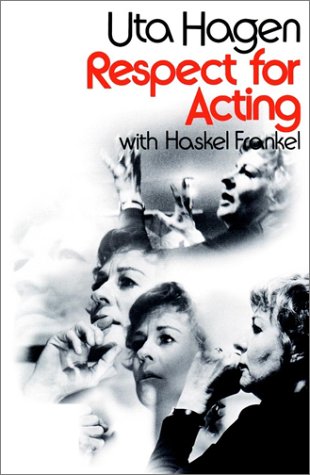
In my twenties when the first veer of my work life occurred, this exploitation of other people’s writing served me very well; it’s how I became the alcoholism counselor of Saratoga County New York fifty years ago, but that story was told here. The veering continued and to a significant extent the collecting of quotes aided its progress from that job to Executive Director of the County Drug Agency, the Family Counselor at the late lamented St. Vincent’s Hospital in Greenwich Village, and eventually by the time my first child was on the way in 1984 Educational Director at Gracie Square Psychiatric Hospital on the Upper East Side. A parallel track of literary prospecting had begun earlier when Alan Brody than head of the Theatre Department at Skidmore College invited (incited?) me to be a ringer in his regional productions. Now the quotes hoarded were from books by Harold Clurman, Uta Hagen, Stanislavski. Leading this double life meant that the books for all of these projects became too many to haul from gig to gig. Notebooks worked for a time, but once the personal computer arrived along with the realization that some of these gems had multiple applications, I started a dump them into the now enormous Word document by copying or dictating them, sending emails to myself marked ‘quotes x’, or forwarding screenshots of the words deemed worthy and wise.
This practice of marking and culling is neither new nor rare. But many practitioners stop defacing their books with underlinings and marginalia once their formal studies end; degree in hand, the pen is put down. In those cases, the purposes of the exercise were ordained rather than adopted or even invented. Some of us keep inspecting and inscribing our books, and if library books then we scribble on whatever is handy a receipt, a flyer. These days we can achieve the desired result with a dictated email requires having two pieces of information alongside each other rather than just flipping to the fly leaves or printers blanks of the book where our notes (that sometimes no longer make the same sense they did when we wrote them) wait for us to make something of them that will be our own.
Perhaps ‘quotations’ fails to describe specifically what was sought: aphorisms were my nerdy passions. Those looking to spar in intellectual conversations recognize early the value of enlisting other greater minds to reinforce your verbal sallies. The name matters — Winston Churchill, Samuel Johnson, Hannah Arendt, Julian of Norwich — but the quality of thought, a “principle or precept expressed in few words; a short pithy sentence containing a truth of general import.” Christopher Marlowe in introducing the audience to Doctor Faustus wants us to appreciate the intellectual power of the man by telling that his “common talk (is) sound aphorisms.”
Thus once the internet arose as I was in the middle of my Masters degree in Computer Assisted Technology in Education there came addtional quote sources. online. My favorite these days is the excellent Quote Investigator. The gathering of quotes themselves did not become a goal until seeing other commonplace books. Once I started compiling them regularly, my eclectic taste showed prominently. Here’s a screenshot of all of the topics that have arisen out of this project over the last 30 years:
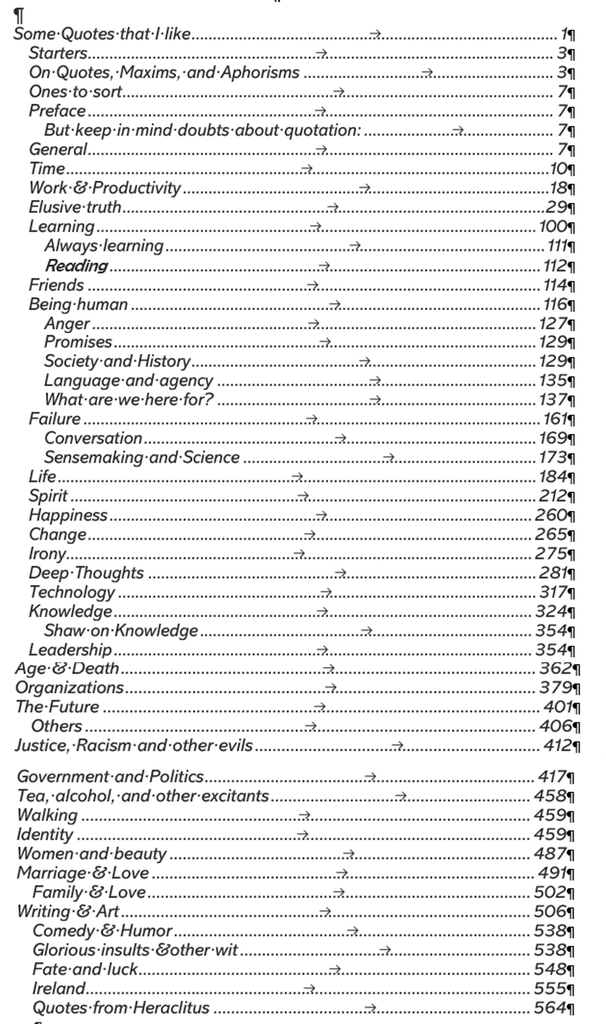
The categories are imperfect. And taking the time to better index all of these quotes is no longer a good use of my time. After all, I’m still ading quotes to the collections. Why? Joel Miller pointed me recently to an ancient example and defense of quote-mining:
“Consider this from the Latin grammarian Macrobius (quoted in my book [The Idea Machine] and properly attributed, naturally):
‘We ought in some sort to imitate bees; and just as they, in their wandering to and fro, sip the flowers, then arrange their spoil and distribute it among the honeycombs, and transform the various juices to a single flavor by some mixing with them a property of their own being, so I too shall put into writing all that I have acquired in the varied course of my reading . . . For not only does arrangement help the memory, but the actual process of arrangement, accompanied by a kind of mental fermentation which serves to season the whole, blends the diverse extracts to make a single flavor; with the result that, even if the sources are evident, what we get in the end is still something clearly different from those known sources.‘
Joel went on to point out that “Ironically, Macrobius borrowed this idea from Seneca, but—true to his point—he expanded Seneca’s original observation
.
My resulting commonplace book skewed towards whatever occupied me at that particular moment. Reviewing now those scribblings in the back of books (which also contained other messages to myself about planned and possible projects some of which DID come to fulfilment), they embalm past searches for material trying to supply some immediate need and occasionally a phone number that reminds me of an escapade better forgotten. What were the needs?
- The creation of consulting products after leaving the behavioral health field altogether in exiting my post in American Airlines Employee Relations. Insights of which competitors and clients were either ignorant or disinterested propelled me into the organizational development business. (My inspiration was a book encountered while teaching at NYU, Management Gurus: What Makes Them and How to Become One by Andrzej Huczynski. No side notes there because it belonged to the tremendous Bobst Library, but lots of dimes spent copying its pages.) Recycling such knowledge is good for the corporate environment if you can get the machers of commerce and the nabobs of institutions to apply the stuff, but as one elusive truth that Upton Sinclair captured revealed “It is difficult to get a man to understand something, when his salary depends upon his not understanding it!” New knowledge generally means unlearning, maybe even shifting your job, and that is scary because as Bas Verplanken once summed up his years of research to me on the process of effecting change, “People tend to do what they tend to do.” My success in using the material did not always translate into an organization’s or department’s success and my errors in application or flares of temperament played a part in some of those ‘unsuccesses’. A commonplace book is not a philosophers’ stone But it along with interaction and alliance with other people seeking elusive truth helped me navigate to better and more beneficial opportunities. There I’ve shared an elusive truth with you.
- Material for plays I wanted to write. #1’s demands kept me form writing most of them until 2018, but the notetaking and quote-catching, which gave me hope that someday playwrighting might return as a regular occupation, continued apace during my straight job years.
- Theological or philosophical questions that occupied me at a particular phase of life as the river of time took me as the parent of young children keeping my head above the currents through the piranha infested rapids of corporate life to my current state of old guy drifting happily but quite aware of the
tick-tock of time and my unwinding that lies ahead.
Whatever technical categories such as instruction, knowledge, measurement, technology, productivity, and strategy proved valuable in the twists of my consulting gigs and then especially after joining ETS 25 years ago as their Chief Learning Officer, elusive truth endured as an abiding interest. Why? It goes back to Father Reynold Borzaga at Manhattan College and maybe to the Jesuits before that at St Peter’s Prep: teachers who excited and interest in the truth even as they admitted the difficulty if not impossibility of finding that substance. Of course, that is one subject where more exploration does not guarantee any sense of sureness. The chase affords both delight and disturbance and does carry a cost if every book that seems to promise some guidance is purchase now matter how exasperated your partner becomes.
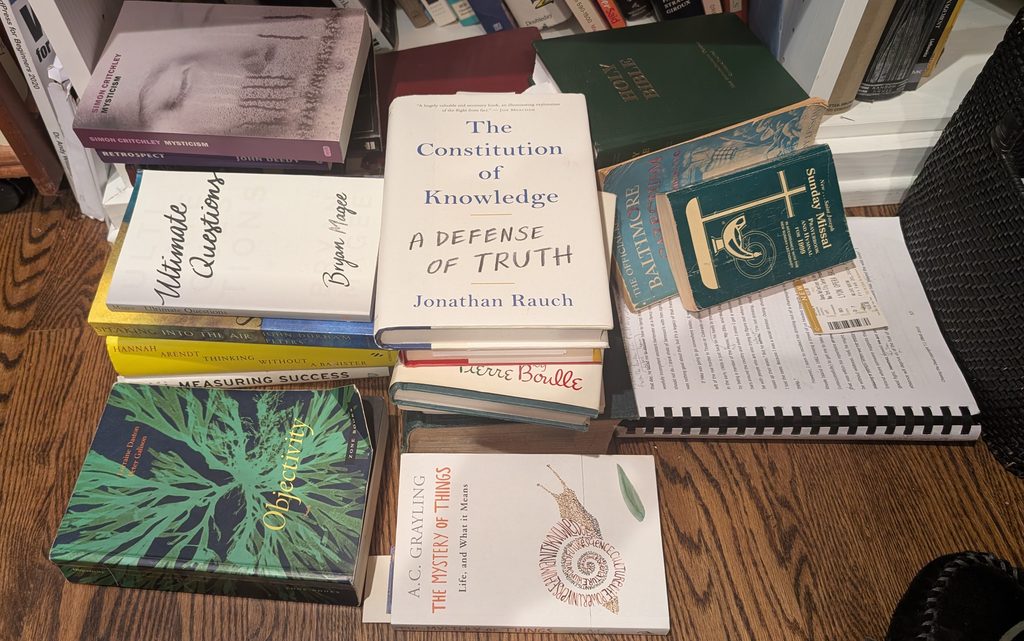
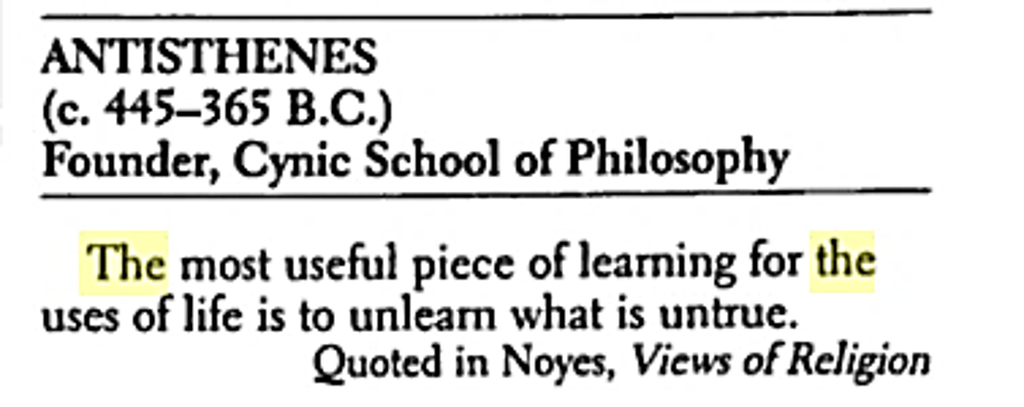
My efforts were not confined to such general texts. Perhaps inspired by my father’s 95 cent George Seldes paperback, I have acquired many different quotation collection books some of them out of the ordinary like this one below that contains some excellent thoughts on our subject elusive truth. Consider these example and do feel free to check my translations::
Truth is a torch that gleams through the fog without dispelling it
La verite est un flambeau qui luit dans le brouillard sans le dissiper
Helvetius
“Truth, like light, blinds. The lie, on the contrary, is a lovely twilight that gives value to every object.“
La verite, comme la lumiere, aveugle. Le mensonge, au contraire est un beau crepuscule qui met chaque objet en valeur
Albert Camus, La Chute
“Truth is on the March nothing can stop it now“
La verite est en marche; rien ne peut plus l’arreter
Emile Zola
Truth does not do as much good in the world as the semblance of truth does evil,” – Duc de La Rochefoucauld, Maxims, 64.
This search is not always overly serious. In looking for the truth, HL Mencken keeps us on our toes with this quote:
Explanations exist; they have existed for all time; there is always a well-known solution to every human problem—neat, plausible, and wrong
So, here is the second of three installments of my remaining entries under the heading of Elusive Truth
Ideas of truth swing in many directions; often in a skeptical attitude as to whether we can find it anywhere.
Consider Descartes…
Misunderstanding is a barrier to finding that elusive truth and Charles Taylor had something to say about that issue:
“Why can someone always misunderstand? And why don’t we have to resolve all these potential questions before we can understand ourselves? The answer to these two questions is the same. Understanding is always against the background of what is taken for granted, just relied on. Someone can always come along who lacks this background, and so the plainest things can be misunderstood, particularly if we let our imagination roam…”
Charles Taylor, Philosophical Arguments
Similarly Borzaga interpreting Karl Jaspers offers both optimism regarding truth and realization that our subjectivity unconsciously may block attaining truth if it collides with our belief system:
“Truth is what unites us. This is the ‘leit motiv’ of Karl Jasper’s life. But truth has a peculiar nature: it becomes meaningless if it is not alive: it will be either fecund or sterile. Jasper’s accepted this challenge. He knew that he had to make new contacts, to establish new communications, to seek out spiritual exchanges with human beings outside the sanctuary of his family…. The Weltanschauung, a view of the world… The way the world presents itself to the individual man, a world that is pregnant with meaning, reminiscence, values and structures differing for different persons. This view evidently presupposes a viewer; In this sense it is not outside but inside each one of us. We belong so strongly to our view that for us it is no longer just a view, it becomes truth, our truth. The deeper and stronger this view becomes, the more it shrinks and grows restless when faced by other points of view: attention is created between the individual convictions and the world that seems to rebel against a singular approach.”
Reynold Borzaga
And there are those with a POV that questions the claims that some make about truth as if it were always settled scientifically
“The mind, whatever else it is, is a constant of everyone’s experience, and, in more and other ways than we know, the creator of the reality that we live within, that we live by and for and despite, and that, often enough, we die from. Nothing is more essential to us…. The character of the thinking that is brought to bear by contemporary writers on the subject, and also to a first premise of modern and contemporary thought, the notion that we as a culture have crossed one or another threshold of knowledge or realization that gives the thought that follows it a special claim to the status of truth…. There is at present an assertive popular literature that describes the mind as if from the posture of science. For the purposes of these writers, it is as if chaste and rational scientific objectivity certified the value of their methods and the truth of their conclusions. The foil for their argument, sometimes implicit usually explicit, is that old romantic myth of the self still encouraged by religion or left in its wake as a sort of cultural residue needing to be swept away…. What I wish to question are not the methods of science, but the methods of a kind of argument that claims the authority of science or highly specialized knowledge, that assumes a protective coloration that allows it to pass for science it does not practice the self-discipline or self criticism for which science is distinguished.”
Marilynne Robinson, Absence of Mind

fine soul, deep heart
AC Grayling quotes William Hazlitt to somewhat the same effect regarding the philosophers conducting investigations how about what is truth:
“William Hazlitt can be quoted to effect here—the investigations conducted by today’s philosophers are lost in the labyrinths of intellectual abstraction, or intricacies of language. The complaint so often made, and here repeated, is not to the want of power in these men, but of the waste of it; not of the absence of genius, but the abuse of it. They had (many of them) great talents committed to their trust, richness of thought, and depth of feeling, but they chose to hide them (as much as they possibly could) under a full show of learning and unmeaning subtlety. From the style which they had systematically adopted, they thought nothing done till they had perverted simplicity into affectation, and spoiled nature by art. They seemed to think there was an irreconcilable opposition between genius, as well as grace and nature; tried to do without, or else constantly to thwart her; left nothing to her outward ‘ impress’ , or spontaneous impulses, but made a point of twisting and torturing almost every subject they took in hand, till they had fitted it to the mould of their own self opinion and the previous fabrications of their own fancy, like those who pen acrostics in the shape of pyramids, and cut out trees into the form of Peacocks. Their chief aim is to make you wonder at the writer, not to interest you in the subject; And by an incessant craving after admiration, they have lost what they might have gained with less extravagance and affectation.”
Hmmm. Should I take that one personally?
Let’s unfurl the rest of this installment sans commentary:
1647 Baltasar Gracián wrote “Oráculo Manual y Arte de Prudencia” (“The Art of Worldly Wisdom”) which included a germane discussion of fools stubbornly clinging to incorrect beliefs. Here is a translation of Baltasar’s Spanish remarks into English: 2
“Every blockhead is thoroughly persuaded that he is in the right, and every one who is all too firmly persuaded is a blockhead, and the more erroneous is his judgment the greater is the tenacity with which he holds it.“
Human beings, who are almost unique in having the ability to learn from the experience of others, are also remarkable for their apparent disinclination to do so.
Douglas Adams
There are only two ways of telling the complete truth–anonymously and posthumously.
– Thomas Sowell
la vérité est qu’une sottise, même après avoir passé par un million de bouches, n’en reste pas moins une sottise.
. . . the truth is that a stupidity, even after having passed through a million mouths, does not become less foolish.
J. A. Schmit, 1874, Revue Catholique, Volume 37, La Dogmatique Révolutionnaire by, , Aux Bureaux De La Revue, Louvain, Belgium. (Google Books Full View) link ↩
“Stupidity is a more dangerous enemy of the good than malice. One may protest against evil; it can be exposed and, if need be, prevented by use of force. Evil always carries within itself the germ of its own subversion in that it leaves behind in human beings at least a sense of unease. Against stupidity we are defenseless. Neither protests nor the use of force accomplish anything here; reasons fall on deaf ears; facts that contradict one’s prejudgment simply need not be believed- in such moments the stupid person even becomes critical – and when facts are irrefutable they are just pushed aside as inconsequential, as incidental. In all this the stupid person, in contrast to the malicious one, is utterly self-satisfied and, being easily irritated, becomes dangerous by going on the attack. For that reason, greater caution is called for than with a malicious one. Never again will we try to persuade the stupid person with reasons, for it is senseless and dangerous.”
Dietrich Bonhoeffer in one of his last letters
In December 1906 Mark Twain dictated remarks for his autobiography which was being published in installments in “The North American Review”. Twain’s comments included the following statement … 3
How easy it is to make people believe a lie, and how hard it is to undo that work again!
Also, in 1906 Mark Twain published “What Is Man?” which included the following prolix passage about people holding tenaciously to established beliefs: 4
We are always hearing of people who are around seeking after Truth. I have never seen a (permanent) specimen. I think he has never lived. But I have seen several entirely sincere people who thought they were (permanent) Seekers after Truth. They sought diligently, persistently, carefully, cautiously, profoundly, with perfect honesty and nicely adjusted judgment—until they believed that without doubt or question they had found the Truth. That was the end of the search. The man spent the rest of his life hunting up shingles wherewith to protect his Truth from the weather“
In 1919 the famous British economist John Maynard Keynes wrote about world leaders who bamboozled, i.e., fooled, U.S. President Woodrow Wilson. “They later discovered that it was difficult to debamboozle Wilson.” 5
In 1927 journalist Norman Angell applied Keynes’s notion to the general population: 6
“. . . it is easier to bamboozle than to debamboozle.”
Despite these reservations, truth matters to us and unsurprisingly Goethe offered a passionate defense of truth
Nothing is great but truth, and the smallest truth is great. The other day I had a thought, which I put like this: Even a harmful truth is useful, for it can be harmful only for the moment and will lead to other truths, which must always become useful, very much so. Conversely, even a useful error is harmful, for it can be useful only for the moment, enticing us into other errors, which become more and more harmful.
1787 Johann Wolfgang von Goethe letter to Charlotte von Stein, translated by Heinz Norden for the book “Goethe’s World View” in 1963
Goethe formulated a more compact version of this idea which was reprinted in “Allgemeine Literatur-Zeitung” (“General Literature Newspaper”) in 1801: 3
I prefer an injurious truth to a useful error.
Truth heals any pain it may inflict on us.
Goethe
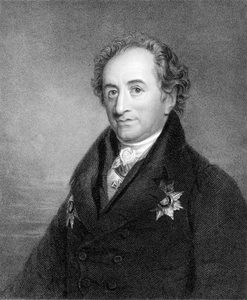
It is not always needful for truth to take a definite shape. It is enough if it hovers about us like a spirit and produces harmony; if it is wafted through the air like the sound of a bell, grave and kindly.
~ Johann Wolfgang von Goethe
“It is precisely because people are aware of the fearful distance that separates us from our beginnings that so many embark upon a search for the roots, the ‘deeper causes’ of what happened. It is in the nature of roots and ‘deeper causes’ that are hidden by the appearances which they are supposed to have caused. They are not open to inspection and analysis but can be reached only by the uncertain way of interpretation and speculation.”
Hannah Arendt, Responsibility, P. 260
Our earlier Camus quote aligns with this one:
“For the truth is bitter and unpleasant to the ignorant; a lie, however, is sweet and appealing “
τὸ μὲν γὰρ ἀληθὲς πικρόν ἐστι καὶ ἀηδὲς τοῖς ἀνοήτοις, τὸ δὲ ψεῦδος γλυκὺ καὶ προσηνές Dio Chrysostom, Oration 11 (“On the Fact that Troy Was Never Sacked”)
And then their is the truth about us…
“We work at knowing the truth about our lifetime even if its images, derived from various people, are not consistent with each other. We exist as separate beings, but at the same time each of us acts as a medium propelled by a power we do not know well, a current of the great river, as it were, through which we resemble each other in our common style or form. The truth about us will remind us of a mosaic composed of little stones of different value and colors.”
Czeslaw Milosz
Try to remember this: what you project
Is what you will perceive; what you perceive
With any passion, be it love or terror,
May take on whims and powers of its own.
Richard Wilbur
Always tell the truth; then you only have to remember one story
Sister Mary Lucille Socciarelli as related by the late Tim Russert
She seems to echo Mr. Twain
If you tell the truth you don’t have to remember anything.
– Mark Twain, Notebook, 1894
“Above all, do not lie to yourself. A man who lies to himself and listens to his own lie comes to a point where he does not discern any truth either in himself or anywhere around him, and thus falls into disrespect towards himself and others. Not respecting anyone, he ceases to love, and having no love, he gives himself up to the passions and coarse pleasures, in order to occupy and amuse himself, and in his vices reaches complete bestiality, and it all comes from lying continually to others and to himself.”
Elder Zozima to Fyodor Pavlovich in The Brother Karamazov
“Veritas odit moras,” is found at line 850 of Seneca’s version of Oedipus. It means “Truth hates delay.”
“I will not stain my story with a lie. A test proves the worth of a man.”
Or is it this in translation
“I will not stain my story with a lie. For experience is the testing ground for mortals.”
Pindar
I know nothing more stupid and indeed vulgar than wanting to be right.
Paul Valery
“Faced with the choice between changing one’s mind and proving that there is no need to do so, almost everyone gets busy on the proof.”
John Kenneth Galbraith
“Clarity drives out ambiguity even if it’s the wrong kind of clarity”
Anonymous ??
I’m trying to speak — to write — the truth. I’m trying to be clear. I’m not interested in being fancy, or even original. Clarity and truth will be plenty, if I can only achieve them.
— Octavia Butler, Parable of the Sower
“To make matters worse, not only do we preferentially seek evidence to confirm our preconceived notions, but we also interpret ambiguous evidence in favor of our ideas. This can be a big problem because data are often ambiguous, so by ignoring some patterns and emphasizing others, our clever brains can reinforce their beliefs even in the absence of convincing data”
Leonard Mlodinow , The Drunkards’ Walk
“Truth scarce ever yet carried it by vote anywhere at its first appearance: New opinions are always suspected, and usually opposed, without any other reason but because they are not already common. But truth, like gold, is not the less so for being newly brought out of the mine. It is trial and examination must give it price, and not any antique fashion; and though it be not yet current by the public stamp, yet it may, for all that, be as old as nature, and is certainly not the less genuine”
John Locke
I’ll close this installment with one of my own:
Being raised as an Irish Catholic affords one the paradox of both believing in absolutes and believing that one can – indeed, should — argue against them.
T.J. Elliott
Read the rest of these installments of In Other Words on Substack