Hurray for Samuel A. A. Levine and his NYT Op-Ed on Customer Service chatbots
about a plunge into ‘the digital labyrinth’ of customer service trying to correct an inaccurate charge on a hotel bill. He notes that “Whether you’re trying to return a purchase, cancel a subscription or recover a hacked account, getting actual help requires a Homeric quest past a morass of junk.” Not sure about the Homeric part — no Circes ever appear in my brushes with these bureaucracies — but the ‘morass’ metaphor works for me. My people are from Ireland, the boggy part and slogging through a morass or two there is unavoidable, frustrating, and exhausting.
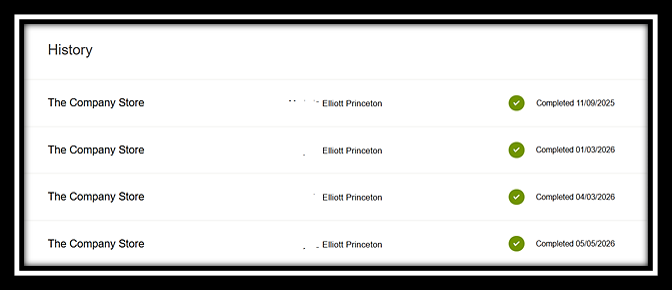
My latest example comes from trying to stop the catalogues we receive from The Company Store The image above shows how many times we’ve tried to stop these annoying mailings via the excellent site Catalog Choice; if you don’t know about it you’re missing a chance to limit the recycling pile at your house. If you go to the Company Store website they say to call their customer service number to unsubscribe from a mailing for which we NEVER subscribed.
That process fits the OED definition of Kafkaesque: “characterized by nightmarish or perplexing circumstances, or subjection to a complex, oppressive, and seemingly illogical bureaucracy.” ‘Seemingly illogical’ appears an apt characterization because why would you wish to engender ill feeling among potential customers? And why waste the cost of the mailing? Foxyeco points out here that these retailers and other companies cut down “Over 100 million trees every year … just to print junk mail that goes unread”
So what is being tested here (besides my patience) given the name of this blog and Substack? The same thing that was being tested in the last Gilded Age: the power of corporations to impose their will upon citizens of the republic. There is no dispute about the right of corporations to send out this dreck; “the (Supreme) Court in Bigelow v. Virginia (1975), and more explicitly in Virginia State Board of Pharmacy v. Virginia Citizens Consumer Council, Inc. (1976), found that advertising did indeed merit constitutional protection, though it was less deserving of protection (emphasis added) than social or political discourse” according to the Free Speech Center at Middle Tennessee State University. But where is the protection for citizens against having to deal with unwanted materials? The Federal Trade Commission directs people to “register at the Association of National Advertisers’ (ANA) website DMAchoice.org and choose what catalogs, magazine offers, and other mail you want to get. DMAchoice will stop most, but not all, promotional mail. You’ll have to pay a $6 processing fee, and your registration will last for 10 years.” It’s eight bucks now, but we did it anyway.
The growth of AI as Samuel A. A. Levine pointed out in his op-ed will further ensnare us in tangles of contact and engagement that are not wanted, needed, or desired. Will representatives on the federal level work to give citizens the choice to be left alone? This will prove consequential as the unwanted encroachments drain our reservoir of attention. As the Scottish philosopher and logician Sir William Hamilton wrote 170 years ago in his lectures on metaphysics “Attention is the voluntary direction of the mind upon an object, with the intention of fully apprehending it.” Our current situation poses many involuntary seizures of attention and we ought to be able to curtail these intrusions. At the risk of appearing satirical, we can waste our attention all on our own and don’t need any help from conglomerates with offers for more ways to enrich them and burden oursleves.

Two years ago Nathan Heller examined this phenomenon of distraction in a New Yorker article. Nathan early on covers the critical concerns: what is the purpose of attention and does making it primarily a mean to economic exchange and value demean its qualities? Here are two illuminating paragraphs on that inquiry:
There is a long-standing, widespread belief that attention carries value. In English, attention is something that we “pay.” In Spanish, it is “lent.” The Swiss literary scholar Yves Citton, whose study of the digital age, “The Ecology of Attention,” argues against reducing attention to economic terms, suggested to me that it was traditionally considered valuable because it was capable of bestowing value. “By paying attention to something as if it’s interesting, you make it interesting. By evaluating it, you valorize it,” he said. To treat it as a mere market currency, he thought, was to undersell what it could do.
The association of bestowing value means that we are giving something to every Instagram reel, Threads, chain, and, yes, Substack post. Avoiding the slightly paranoiac view that brainwashing leads us to such ‘gifts’ of our attention, there is a huge difference in the appearance and materialization of items that require our attention that we never sought now agreed to accept.
Here’s the second paragraph:
Advertisers’ interest in attention as a measure was sharpened with the publication of “The Attention Economy” (2001), by Thomas H. Davenport and John C. Beck, which offered a theory of attention as a prelude to action: we pay attention in order to do (or buy). But there have long been varied views. The neuroscientist Karl Friston has suggested that attention is a way of prioritizing and tuning sensory data. Simone Weil, one of attention’s eloquent philosophers, also resisted the idea of attention as subject to economic measure.

Simone Weil got me to pay attention to the sacred dimension of this action of focusing on something, of doing ‘one thing at once’, with her aphorism: “Attention is the rarest and purest form of generosity.” The sentiment chastised me, multitasker notorious, but also led to adopting the meditation exercises of Basil Pennington and Thomas Keating as a way of practicing attention. And Weil’s insights that “Attention, taken to its highest degree, is the same thing as prayer. It presupposes faith and love…Absolutely unmixed attention is prayer” highlight the profanity of assaults upon mind and spirit by corporations.
I know. This guy starts out complaining about The Company Store not making it easy to stop their catalogues filling his recycling bin and somehow wends his way to a French mystic. But that’s the point. The world created by these various systems may have us devalue our attention but it’s one of the most important resources we possess. It should be held for greater purposes than dealing with corporate obtuseness and overreach. The test for us is to reclaim our attention, to use it for our desires and not to fend or foster the aims of an invading entity.
At the end of that New Yorker articl, Heller is with a group of people, The Order of the Third Bird, who follow a Standard Protocol — Encounter, Attending, Negation, Realizing— to achieve a particlr form of attneiton especillay to art objects. Nathan is with them as they contemplate “a public sculpture by Peter Lundberg, … encircled by a ramp of the George Washington Bridge.” Here’s his final account:
“A wind rose all at once. The waters of the Hudson darkened to a moody gray. The walkway traced a horseshoe shape around the sculpture, and, on an impulse, Nalencz called Realizing while leading the group to a position on the other side of the curve. They made a new phalanx, facing the opposite direction: five people giving everything to an art work hidden for years. Could it have been my own imagination that the steel flanks of the sculpture seemed to flash with new importance under the force of their attention?
It was sunset now; the skyline of New Jersey carried a thin wire of gold. I watched the group wield their strange power on the art work, and it was one of the most real things I have ever seen.”
That’s what attention can do in the best circumstance: give us ‘the most real things’. In the Kafkaesque world of advertisement and flyer, junk mail and flashing displays, our attention is stolen, abused, and lost. I prefer to get real. And to hell with The Company Store.